

TL;DR — how long it takes to install an oven or stove
- A straight electric swap runs 60 to 90 minutes. That is the standard install appointment we book: old range out, new one in, levelled, connected to the existing receptacle and tested.
- Gas, built-in and panel-ready units run 2 to 3 hours. Different job, different appointment length, and in Ontario the gas connection itself has to be made by a TSSA-certified technician.
- The install price is $129 to $249 for a standard freestanding range, or $179 to $349 for a gas appliance, which covers the TSSA work and the leak test at the end.
- What stretches the job: an opening that is not quite square, a three-prong receptacle behind a four-prong cord, an over-the-range microwave sitting too low, or an old unit that still has to come out and be hauled away.
- Booking is a phone call: 647-834-4646, same-day across the GTA, York Region and Simcoe County.
Nearly everyone asking how long it takes to install an oven is really asking one of two things. Either the new range is arriving on Thursday and you need to know whether to take the afternoon off, or the old one has died and you want to know how much of today you are about to lose. The honest answer splits along one line: what the appliance connects to.
An electric range that slides into an opening where a compatible receptacle already exists is a 60 to 90 minute job. A gas range, a wall oven, or anything panel-ready is a 2 to 3 hour job. Which band you land in is decided by what the appliance connects to, not by what it cost or how big it is.
How long does it take to install an oven or stove?
These are the appointment lengths we actually book, by appliance type:
| What is going in | Typical time on site |
|---|---|
| Freestanding electric range, existing compatible receptacle | 60 to 90 minutes |
| Slide-in electric range into a finished counter cut-out | 60 to 90 minutes, longer if the opening needs work |
| Gas range or gas cooktop | 2 to 3 hours |
| Built-in wall oven | 2 to 3 hours |
| Panel-ready or integrated units | 2 to 3 hours |
Those windows assume a replacement, not a first-time install. Swapping like for like means the circuit, the gas stub and the opening are already there and already sized. That is most of the work, and somebody else did it years ago.
If there is no receptacle and no gas line where the range is going, that is a different trade and a separate job. Running a new 240 volt circuit or a new gas line is licensed work that happens before an appliance installer is any use to you. Booking both on the same morning is how people end up with a range sitting in the hallway overnight.

What a 90-minute swap actually consists of
It sounds quick until you list it out. On a standard electric replacement the time goes roughly like this: shut off the circuit and pull the old range forward, disconnect it, get it out of the kitchen, unbox and inspect the new one, transfer or fit the power cord, slide it in, level it against the counter line, fasten the anti-tip bracket, then run it up to temperature and check that every element and the oven actually work before anyone signs anything.
The last step is the one people skip when they do it themselves. A range that physically fits is not a range that has been tested. Bake, broil and each surface element want to be switched on once while somebody is still standing there.
The anti-tip bracket deserves its own sentence. Ranges ship with one, it is meant to be fastened to the floor or the wall, and it is the single most commonly abandoned part of a self-install. It exists so a loaded oven door cannot pull the whole appliance over.
Why gas takes two to three hours, and who is allowed to connect it
A gas range is not a heavier electric range. The extra time is the connection and what has to happen after it.
In Ontario, a gas appliance connection has to be made by a TSSA-certified technician. That is not a company policy, it is the rule the province works under, and it is why a gas install cannot be handed to a general handyman or finished by the delivery crew. We are TSSA-certified for gas, and registered with HRAI and WSIB Ontario.
The work itself: shut off the supply, disconnect the old appliance, check the shut-off valve and the connector, make the new connection, then leak-test it before the range is left in service. That leak test is part of the gas install price, not an extra.

That outlet catches people out constantly. The gas line feeds the burners. It does not run the electronics. If a gas range is going somewhere that has never had one, the checklist is a gas connection and a standard receptacle within reach.
Range delivered, gas line there, nobody certified to connect it? That is a routine call for us. TSSA-certified gas connection with a leak test, same day across the GTA, York Region and Simcoe County from our Bradford and Barrie locations.
Built-in and wall ovens: the cabinet is the job
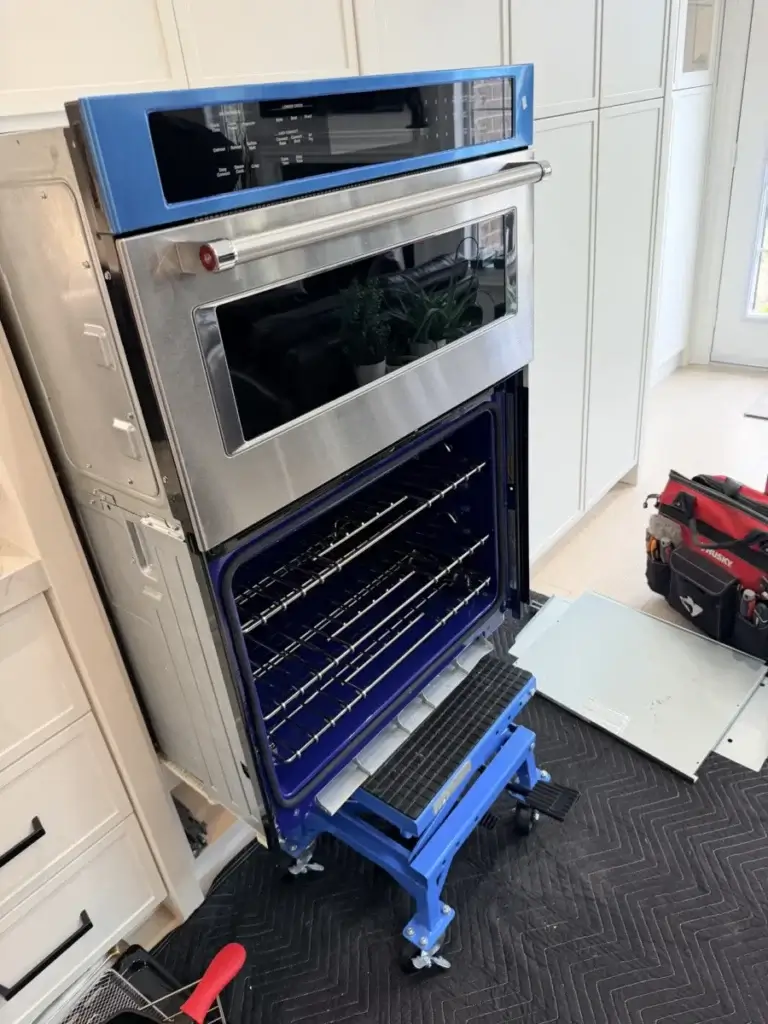
A freestanding range stands on the floor and plugs in behind itself. A built-in oven does neither. It is carried into a cabinet opening, supported while it is fastened, and connected at its own terminal inside that opening, which somebody has to physically reach.

Add the weight. Wall ovens are awkward, heavy, and usually installed at chest height, so they are a two-person lift into a hole with no margin. Between the lift, the cabinet fixings and the connection, two to three hours is realistic and one hour is not.
What turns a 90-minute swap into a half day
Most overruns come from four things, and all four can be checked before the appliance arrives.
- The opening is not what the spec sheet expects. Standard is 30 inches, but old cabinetry drifts, and slide-in ranges are far less forgiving than freestanding ones because they are meant to sit flush against the counter cut-out.
- The receptacle does not match the cord. Older houses often have a three-prong range receptacle; newer ranges commonly ship for a four-prong. Ranges frequently arrive with no cord at all. Sorting that out at the van costs time that a five-minute look behind the old range would have saved.
- The over-the-range microwave is too low. Taller ranges and lower microwaves are both trends, and they meet in the middle of somebody’s kitchen. Measure from the counter to the underside of the microwave before the range is delivered.
- The old appliance is still there. Disconnecting and removing it is real time, and so is getting it out of the house. We do the disconnect and code-compliant haul-away, but it is work, and it belongs in your estimate of the morning.
Flooring is the quiet fifth one. If new tile or vinyl went in around the old range, the opening may now be shallower or the range may no longer slide flat. It is worth a look before delivery day.
Replacing an oven versus installing where there was none
The replacement question and the first-install question get typed into Google in nearly the same words, and they have very different answers. Most people asking how long it takes to install an oven mean the first case, where something is already there.
Replacing: the connection point exists, so you are inside the windows above. Sixty to ninety minutes electric, two to three hours gas or built-in.
Installing where nothing was: the appliance install is still 60 to 90 minutes. What comes first is not. A new 240 volt circuit is electrical work. A new gas line is gas fitting. Those are booked, done and finished before the range install is worth scheduling, and they are what actually determines your timeline.
Older homes: an older house may have outdated or non-compliant gas and electrical systems, and that work has to be brought up to code before the installation can proceed safely.
How to keep the job at the fast end
Five minutes with a tape measure and a phone camera saves most of the delays we see.
- Measure the opening: width, depth and height, and note if the counter overhangs.
- Photograph the receptacle behind the old range, and count the prongs.
- Measure from the countertop to the bottom of the over-the-range microwave, if there is one.
- Check whether the new range came with a power cord, or a gas connector, or neither.
- Clear a path from the door to the kitchen, and decide where the old appliance is going.
- Have the shut-off accessible: the breaker for electric, the valve for gas.
Send those photos when you book and the technician arrives with the right cord and the right connector on the van, which is the difference between one visit and two.
What oven and stove installation costs
Standard installation, which includes a freestanding range, is $129 to $249. Gas appliance installation, which covers the TSSA work and the leak test, is $179 to $349.
Cords, venting and shut-off valves are priced into the quote rather than added at the end. The $89 service call you will see elsewhere on our site applies to repair diagnostics, not to a straightforward installation.
Not sure whether you need an install or a repair? If the old range is still under warranty or the fault is a single element or igniter, a repair is often the cheaper morning. See appliance installation services, oven and stove repair, or gas appliance service. We work on Whirlpool, KitchenAid and every other major brand.
Oven and stove installation: quick answers
How long does it take to install an oven?
A standard freestanding electric oven or range takes 60 to 90 minutes to install when there is an existing compatible receptacle. A built-in wall oven takes 2 to 3 hours, because it has to be lifted into a cabinet opening and connected at its own terminal inside that opening.
How long does it take to install a stove?
An electric stove is a 60 to 90 minute job. A gas stove is 2 to 3 hours, because the gas connection has to be made by a TSSA-certified technician in Ontario and leak-tested before the appliance is left in service.
How long does it take to replace an oven?
Replacing is the fast case, because the circuit or gas connection is already in place and already sized. Expect 60 to 90 minutes for a like-for-like electric replacement, and 2 to 3 hours for gas or a built-in, plus a little time to disconnect and remove the old unit.
How long does it take to install a gas stove?
Two to three hours. The connection, the shut-off valve check and the leak test are what separate it from an electric swap, and in Ontario that connection legally has to be made by a TSSA-certified technician.
How long does it take to install a gas appliance?
For a gas range or gas cooktop, two to three hours. In Ontario the gas connection has to be made by a TSSA-certified technician, who shuts off the supply, disconnects the old appliance, checks the shut-off valve and the connector, makes the new connection and leak-tests it before it is left in service. If new gas lines have to be run, or the existing piping needs work, that is separate licensed work done before the appliance install. Improper installation can lead to gas leaks, fire hazards or appliance malfunction.
Do I need an electrician to install an oven?
Not if you are replacing one and a suitable receptacle is already there. You do need an electrician if a new 240 volt circuit has to be run, or if the existing receptacle does not match the new range. That is separate work, booked before the install.
Can I install a gas range myself in Ontario?
The gas connection has to be made by a TSSA-certified technician. That is the rule in Ontario, and it is also what a leak test at the end is for.
Does a gas range need an electrical outlet?
Yes. Ignition, controls, clock and oven light all run on standard household power. A gas range needs a regular 120 volt receptacle within reach as well as the gas connection.
Will you take the old oven or stove away?
Yes. We disconnect the old appliance, including gas, water or electrical, and haul it away code-compliantly. Mention it when you book so the time is in the appointment.
Installing a new oven or stove in the GTA?
Same-day appliance installation across Toronto, York Region and Simcoe County, from our Bradford and Barrie locations. Electric ranges, gas ranges and built-in wall ovens, with TSSA-certified gas connection and a leak test on every gas install. Standard installation $129 to $249, gas $179 to $349, old unit disconnected and hauled away.