

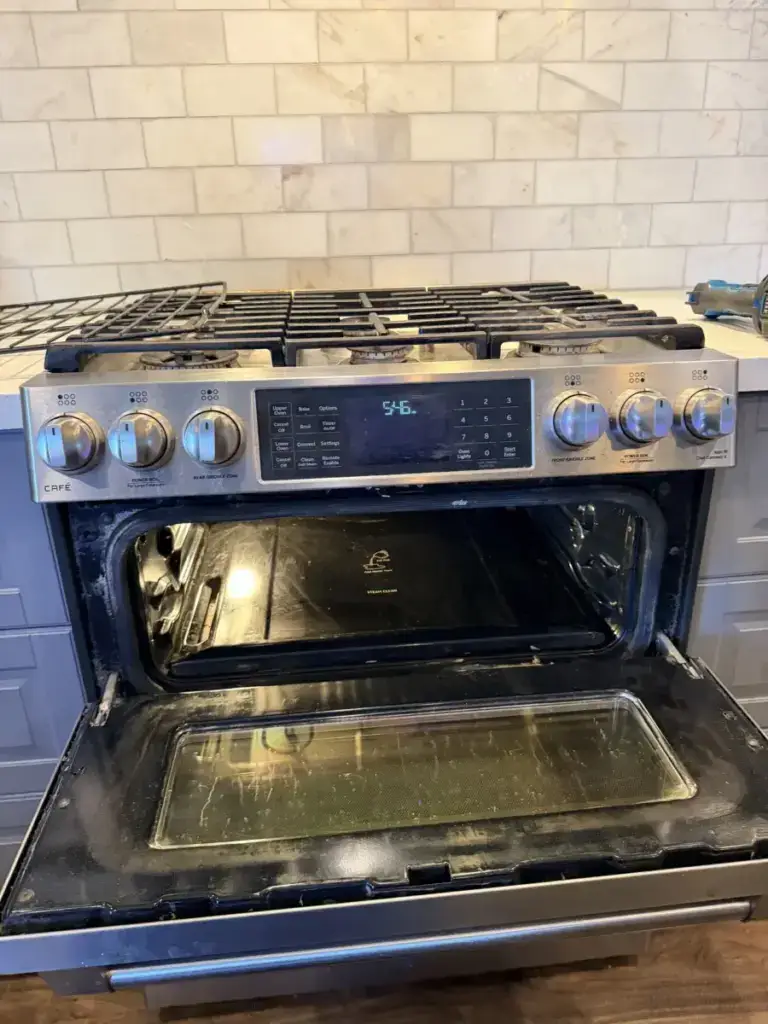
3-second answer: If your oven turns on, lights up, and the timer works, but it never gets hot — or never reaches the temperature you set — the fault is in the heating circuit, not the controls. On an electric oven the most common cause by far is a burnt-out bake element; on a gas oven it is almost always a weak or failed igniter that no longer gets hot enough to open the gas safety valve. After that come bad temperature sensors, control-board faults, and power-supply problems like one tripped leg of a 240V circuit. Most of these are diagnosable in a few minutes by looking and listening, and a couple are safe to confirm with a $15 multimeter. But element, valve, and board replacements — and all gas work in Ontario — belong to a qualified technician. This guide is the comprehensive version of our older note on why an oven won’t heat up properly.
In this guide
First: is it electric or gas? Tell the symptoms apart
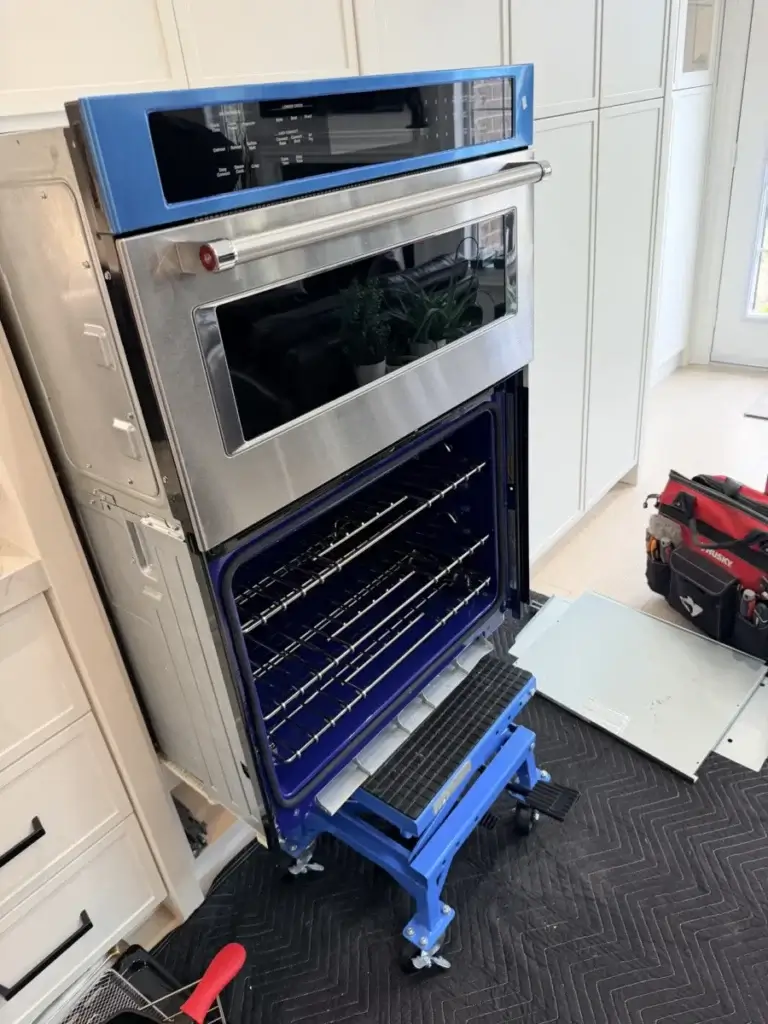
Before you chase a single part, figure out which kind of oven you have — it cuts the list of possible causes roughly in half and changes what’s safe to touch. A gas oven has a flexible gas line at the back and burns a visible flame inside the cavity. An electric oven has a heavy 240V cord, no gas line, and heats with one or two glowing metal bars (the bake element on the floor, the broil element on the roof).
The seven causes below are tagged electric or gas so you can skip the ones that don’t apply.
The 7 most common causes of an oven not heating
Across the GTA, York Region, and Simcoe County, here are the seven causes we see most often, ranked roughly from most to least common. Work down the list in order and you’ll usually land on the fault before you reach the rare ones.
- Burnt-out bake element — the most common cause on an electric oven
- Failed or weak igniter — the most common cause on a gas oven
- Bad oven temperature sensor — oven heats but never reaches the set temp
- Faulty broil element — electric; broiling fails but baking may still work
- Gas safety valve not opening — gas; often the consequence of a weak igniter
- Control board / spark or ignition module fault — no heat signal reaches the element or burner
- Tripped breaker or one dead leg of a 240V circuit — the cause people overlook
1. Burnt-out bake element (electric — most common)
The bake element is the looped metal bar on the floor of the cavity that does most of the heating. It runs on 240V and, after years of expanding and contracting, the wire inside eventually breaks or burns through. When it fails the oven powers on normally — lights, fan, display all work — but the cavity never warms up. This is the single most common reason an electric oven won’t heat.
How to spot it: Set the oven to bake and watch the bottom element for a few minutes. A healthy element glows evenly orange end to end. A dead one stays dark; a failing one shows a visible break, a blistered spot, or bright arcing. It’s one of the more DIY-friendly fixes — the element usually unscrews from two terminals at the back wall.

2. Failed or weak igniter (gas — most common)
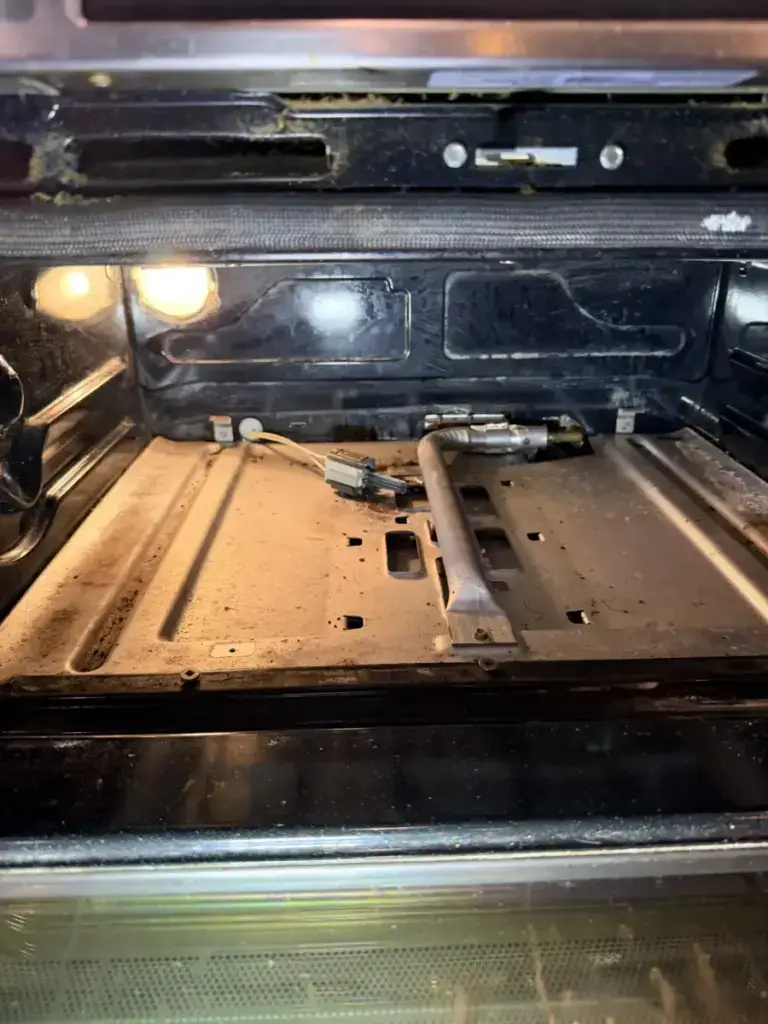
The igniter does two jobs at once: it glows hot to light the gas, and the current it draws is what tells the gas safety valve to open. Over time it weakens — it still glows, but no longer draws enough current to open the valve, so gas never flows and the burner never lights. This is the number-one cause of a gas oven not heating, and the reason a weak igniter is so often misread as a gas-supply problem.
How to spot it: Set the oven to bake and watch the burner area through the bottom panel. If the igniter glows bright for more than about 90 seconds and the gas never lights, it’s too weak to open the valve and needs replacing. If it doesn’t glow at all, the fault is upstream — the ignition module or wiring. Igniter and gas-valve work in Ontario must be done by a TSSA-certified technician; watching the glow is a safe diagnostic, but the repair is not a DIY job.
3. Bad oven temperature sensor
The temperature sensor (a thin metal probe near the top-rear of the cavity) tells the control board how hot the oven is. If it drifts or fails, the board gets a false reading and cuts the heat early — so the oven warms a little but never reaches the set temperature. Both electric and gas ovens have one.
How to spot it: The oven heats but runs cold or never hits temperature. With the oven unplugged, a multimeter across the sensor terminals should read roughly 1,080–1,100 ohms at room temperature; a reading far off that, or an open circuit, points to a failed sensor. It’s an inexpensive part and a common fix when the complaint is “heats but not enough.”
4. Faulty broil element (electric)
The broil element is the bar across the top of the cavity. If it burns out while the bake element is fine, the oven still bakes but won’t broil — or, on some models, the loss of the broil element throws the whole heating system into a fault. Like the bake element, it can fail visibly, with a break or a blistered, arced spot.
How to spot it: Run the broiler and watch the top element — it should glow bright orange across its length. No glow, an uneven glow, or a visible break means it’s failed. A multimeter across its terminals (oven unplugged) reads continuity on a healthy element and an open circuit on a dead one.
5. Gas safety valve not opening (gas)
The gas safety valve releases gas to the burner only when it sees enough current flowing through the igniter. If the igniter is healthy and drawing full current but gas still doesn’t flow, the valve itself may have failed. In practice a weak igniter is the far more common reason the valve never opens, so a good technician confirms the igniter’s current draw before condemning the valve.
How to spot it: The igniter glows strong and steady but the burner never lights. Telling a bad valve from a weak igniter means measuring current draw. The gas safety valve is a gas-side component — testing and replacing it requires a TSSA-certified technician in Ontario.
6. Control board / spark or ignition module fault
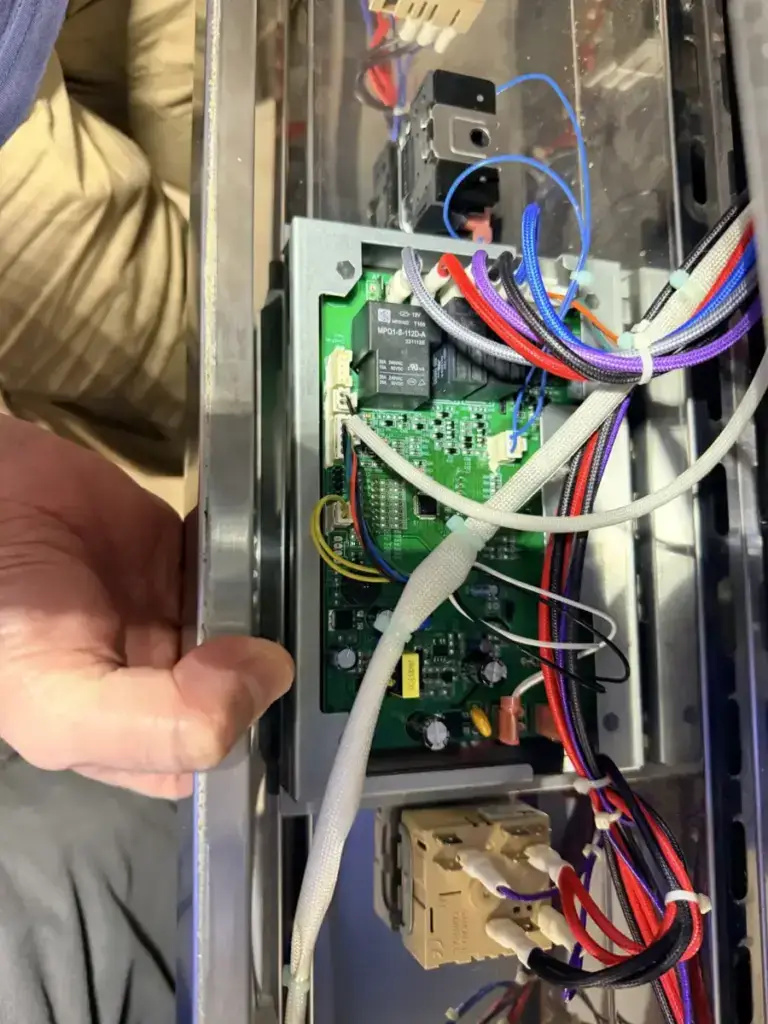
The control board sends the heat-call signal. On an electric oven a failed relay on the board can stop power reaching the element even though everything downstream is healthy. On a gas oven the spark or ignition module energizes the igniter — if it fails, the igniter never glows. This is the least common cause and the hardest to diagnose, because it usually surfaces only after the element/igniter, sensor, and valve have all tested good.
How to spot it: On electric, the element never glows yet tests fine and both breakers are on. On gas, the igniter never glows and its wiring is intact. Board and module diagnosis is a tech-level job — replacing a board on a guess is an expensive mistake.

7. Tripped breaker or one dead leg of a 240V circuit (electric)
This is the cause people overlook because the oven looks alive. An electric oven is fed by a double-pole 240V breaker — two 120V legs. The control panel, light, and fan run on a single leg, so if one leg trips the oven powers on and the display works, but the elements (which need both legs) get no heat.
How to spot it: The controls work but neither element ever heats. Firmly reset the breaker — switch it fully OFF, then back ON (a tripped breaker can sit in a deceptive middle position). If the heat comes back, you’re done; if it trips again immediately, stop and call a pro — that’s a wiring fault, not a nuisance trip.
Safety first. Before opening any panel or pulling the oven out, unplug an electric oven at the wall, or switch off its breaker. On a gas oven, shut the gas valve at the appliance and kill the power. Never test, repair, or replace a gas-side component — igniter, gas valve, burner, or supply line — yourself: in Ontario that work legally requires a TSSA-certified technician.
Safe DIY checks — step by step
Set aside 20–30 minutes. You’ll need a flashlight, a screwdriver, and — for the element and sensor tests — a $15 multimeter. Cut power (and gas, on a gas oven) before opening anything. Work in this order and stop at the first step that explains your symptom.
- Confirm the oven actually has full power. If it’s electric and the controls work but nothing heats, the prime suspect is a single tripped leg of the 240V circuit. Switch the oven’s breaker fully OFF, then firmly back ON. If the breaker trips again right away, stop — that’s a wiring fault for a pro.
- Watch the heating components glow. Electric: set it to bake, give it a few minutes, and look — the bottom (bake) element should glow even orange end to end; switch to broil and check the top element the same way. A dark or partially-glowing element is your answer. Gas: pull the oven floor panel and watch the igniter — it should glow, then the burner should light within about 90 seconds.
- Look for the obvious physical failure. With the oven cool and unplugged, inspect each element for a break, a blistered swollen spot, or a bright burn mark where it arced. A visibly damaged element is a confirmed fault — no meter needed.
- Test continuity on an electric element (optional, meter required). Oven unplugged. Disconnect one element lead and probe both terminals on continuity: a healthy element beeps / reads low ohms; an open circuit (OL) means it’s burnt out. The temperature sensor should read about 1,080–1,100 ohms at room temperature.
- For gas: watch the igniter, then stop. If the igniter glows strong but the burner never lights, or it doesn’t glow at all, you’ve narrowed it to the igniter, valve, or module — all gas-side. Note what you saw and book a TSSA-certified technician. Do not attempt to test or replace the gas valve, igniter, or burner yourself.
Breaker reset, both elements glow, sensor reads right — and the oven still won’t heat properly? That points to a control-board relay, a gas-side fault, or wiring — components that need a technician. Book a same-day GTA appointment: 647-834-4646 ($89 service call applied to the repair if you go ahead).

When to stop and call a pro
Call us if any of these apply:
- It’s a gas oven and the fault isn’t a tripped breaker — igniter, gas valve, burner, and ignition-module work all legally require a TSSA-certified technician in Ontario
- An electric element needs replacing and you’re not comfortable working inside a 240V appliance
- The breaker trips again immediately after you reset it (a wiring fault, not a nuisance trip)
- The element, sensor, and power all test good but the oven still won’t heat (points to the control board)
- There’s a gas smell, a burning-electrical smell, or visible arcing/sparking
- The oven heats but is badly off temperature and a new sensor didn’t fix it
- You don’t have a multimeter or aren’t sure which part you’re looking at
Appliance Forever covers the entire GTA, York Region, and Simcoe County — Vaughan, Markham, Aurora, Newmarket, Bradford, Barrie, Innisfil, Scarborough, North York, Richmond Hill, and beyond. We’re TSSA-certified for gas appliances, factory-trained across 30+ brands, fit OEM parts, and our $89 service call applies to the repair. Book same-day at 647-834-4646 or browse our oven & stove repair services. Related reading: oven not turning on, oven making unusual noises, and 5 signs your oven needs repair. For the original short note this guide expands on, see why is my oven not heating up properly.
FAQ — quick answers
Why is my oven not heating up but the light and controls still work?
Because the control circuit and the heating circuit are separate. The display, light, and fan can run while the heat source is dead. On an electric oven the usual culprit is a burnt-out bake element or a single tripped leg of the 240V circuit (the controls run on one leg, the elements need both). On a gas oven it’s almost always a weak igniter that no longer opens the gas valve. Start by watching whether the element glows or the igniter lights.
How do I know if my oven element is bad?
Set the oven to bake and watch the bottom element: a healthy one glows bright orange evenly along its whole length within a few minutes. A bad element stays dark, glows only in patches, or shows a visible break, blister, or burn mark where it arced. To confirm, unplug the oven and check continuity across the element terminals with a multimeter — an open circuit (no continuity) means it’s burnt out and needs replacing.
Why does my gas oven igniter glow but the oven never gets hot?
That’s the textbook sign of a weak igniter. The igniter has to draw enough current to open the gas safety valve; as it ages it still glows but draws less current, so the valve never opens and gas never reaches the burner. The fix is a new igniter — but igniter and gas-valve work is gas-side and legally requires a TSSA-certified technician in Ontario, so this one isn’t a DIY repair even though the diagnosis is easy to see.
My oven heats but never reaches the temperature I set — what’s wrong?
If the oven warms up but runs cold or never hits the dial, the most likely cause is a failed or drifting temperature sensor feeding the control board a wrong reading, so it cuts the heat too early. A worn element that can no longer reach full output can do the same. Check the sensor first — at room temperature it should read about 1,080–1,100 ohms on a multimeter; far off that means replace it.
Can I replace an oven heating element myself?
On an electric oven, yes — if you’re comfortable working inside a 240V appliance with it unplugged. The element typically attaches with two screws at the back wall and two wire leads; you swap it, reconnect, and test. A gas oven has no electric element — it heats with an igniter, gas valve, and burner, all of which require a TSSA-certified technician in Ontario. When in doubt, book the diagnostic rather than guessing at the part.
Is it worth repairing an oven that won’t heat, or should I replace it?
It usually comes down to the part and the age of the oven. An element, igniter, or sensor is an inexpensive, high-value repair that buys years of life. A failed control board on an older oven can approach replacement cost — that’s the point where replacing may make sense. Our $89 service call covers an on-site diagnosis, we quote the repair in writing before any parts work, and every repair carries a 90-day warranty, so you can make the repair-or-replace call with real numbers in hand.
How much does it cost to fix an oven that won’t heat in the GTA?
It depends on the diagnosis. A temperature sensor is at the low end; a bake element, gas igniter, or gas valve is a typical mid-range job; a control board is the high end and varies by model. For typical ranges by repair type, see our oven & stove repair cost guide for the GTA. Prices vary, and the exact figure is confirmed after the $89 diagnostic. That $89 service call is applied to the repair if you go ahead, and every repair is backed by a 90-day warranty. Call 647-834-4646 for a same-day appointment.
Oven still won’t heat after the DIY checks?
Book a same-day appointment across the GTA, York Region, and Simcoe County. Our $89 service call is applied to the repair, the final price depends on the diagnosis, and every repair is backed by a 90-day warranty. TSSA-certified for gas appliances, factory-trained on 30+ brands, OEM parts.
Call now: 647-834-4646 | Book your service online
 Rating
Excellent service! Appliance Forever fixed my fridge quickly and did an amazing job. The technician was professional, friendly, and efficient. My fridge is working perfectly now. I highly recommend them to anyone needing appliance repairs. Thank you!

George and Zack are reliable and great. They come and don’t leave until the problem is fixed. Great service.

Just had George install my Gas Stove in my new build, and he did an amazing job.Also he was very kind to deal with,

I met Zaur today and it was genuinely a very pleasant experience working with him

Zack from Appliance Forever was great. He showed up on time, worked quickly, and had both my fridge and stove range fixed in no time. Super efficient and easy to work with. I’d definitely call him again. Thanks, Zack!

Zack from Appliance Forever has great knowledge of the appliances. He serviced my dishwasher had it up and running in 30 mins. So happy to have my dishwasher working. Great service

Zack and George came by today and they did a great job fixing my dryer. Very polite, as well. Super fast, too.Thank you, gentlemen

My oven had a problem, but Applianceforever quickly fixed it. Great customer service!

Friendly and super fast service. George got my stove and running in no time! Really appreciate their work!

Zack and George great guys amazing service they know all their stuff. Great job.!!!

The team provided timely service. They were professional and successfully completed a drum repair on our washing machine.

George and his team have been to our home a few times to repair our appliances. Each time our issues were corrected. The pre-appointment communication was always good and I appreciate the reminder call, plus the day-of call with the ETA. George and the other gentleman were kind, professional and knowledgeable.

Zack fixed an issue with our Microwave oven which caused it to randomly lose power.

Zack was very friendly

They fixed my oven in just 2 mins very fast service and nice people.