

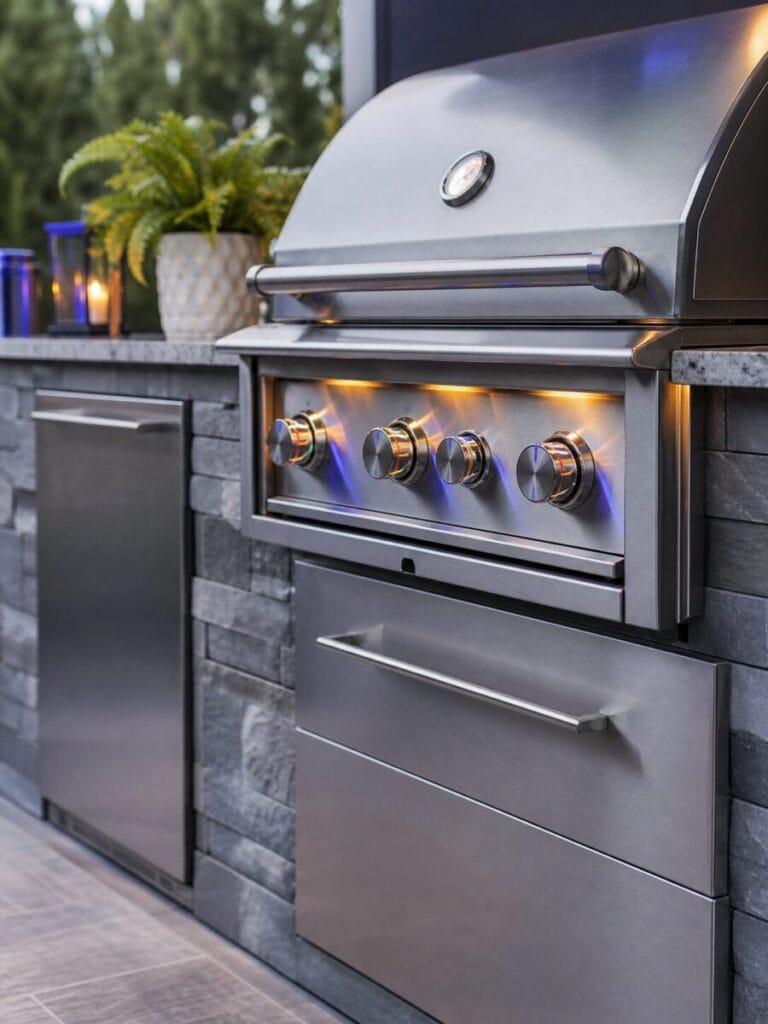
3-second answer: If your built-in BBQ clicks but won’t light, lights then dies, or burns with a weak low flame, the gas is either not arriving, not igniting, or not flowing freely. The most common causes — in the order worth checking — are an empty or low propane tank or a closed gas valve, clogged burner ports (often spider webs after a winter idle), a failed igniter (dead battery or worn spark module), and the regulator stuck in “bypass” mode — the classic low-flame-after-a-fast-tank-connect problem. Most of these are safe to check yourself in 15 minutes. But anything involving the gas line, the regulator itself, a fuel conversion, or a gas smell that won’t clear is a job for a TSSA-certified technician — in Ontario that is the legal requirement for gas-side work. This is the outdoor-appliance companion to our broader gas appliance repair guide.
In this guide
- Why a built-in BBQ won’t light or loses flame
- The start-of-summer tune-up (seasonal angle)
- Stuck in bypass: the low-flame mystery
- Safe 5-step DIY check
- Brand notes: Napoleon, Broil King & Weber
- What built-in BBQ repair costs
- Side burners, outdoor fridges & patio heaters
- When to call a TSSA-certified pro
- FAQ — quick answers
Why a built-in BBQ won’t light or keeps losing flame
A built-in gas BBQ runs three things in sequence: fuel has to arrive at the right pressure, the igniter has to make a spark, and the burner ports have to be clear enough to carry a clean flame. When the grill won’t light, dies, or runs with a stubborn low flame, the fault is in one of those three. Here are the causes we see most often across the GTA, York Region, and Simcoe County, roughly in the order to rule them out.
- Empty/low propane tank or a closed gas valve — the most common and most overlooked
- Clogged burner ports / spider webs — seasonal, very common after a winter idle
- Failed igniter — dead battery, worn electrode, or a faulty spark module
- Grease buildup or blockage in the burner tubes and venturi
- Regulator stuck in bypass (“low flame after a fast tank connect”)
- Burnt-out or corroded burners — the metal itself has failed
- Gas-line or regulator fault — least common, tech-only
1. Empty/low propane or a closed gas valve (most common)
Before anything else, rule out fuel. The single most common reason a built-in BBQ won’t light is also the simplest: an empty or nearly empty propane tank, or a supply valve someone closed and forgot. On natural gas, the manual shutoff at the connection may be partly closed; on propane, the tank valve may be off or the tank simply out.
How to spot it: No flame anywhere, or every burner is weak at once. Check the gauge or lift the tank to judge its weight, and confirm both the tank valve and any inline shutoff are fully open. Open the valve slowly — opening it fast is what triggers the regulator bypass problem covered below.
2. Clogged burner ports and spider webs (seasonal)
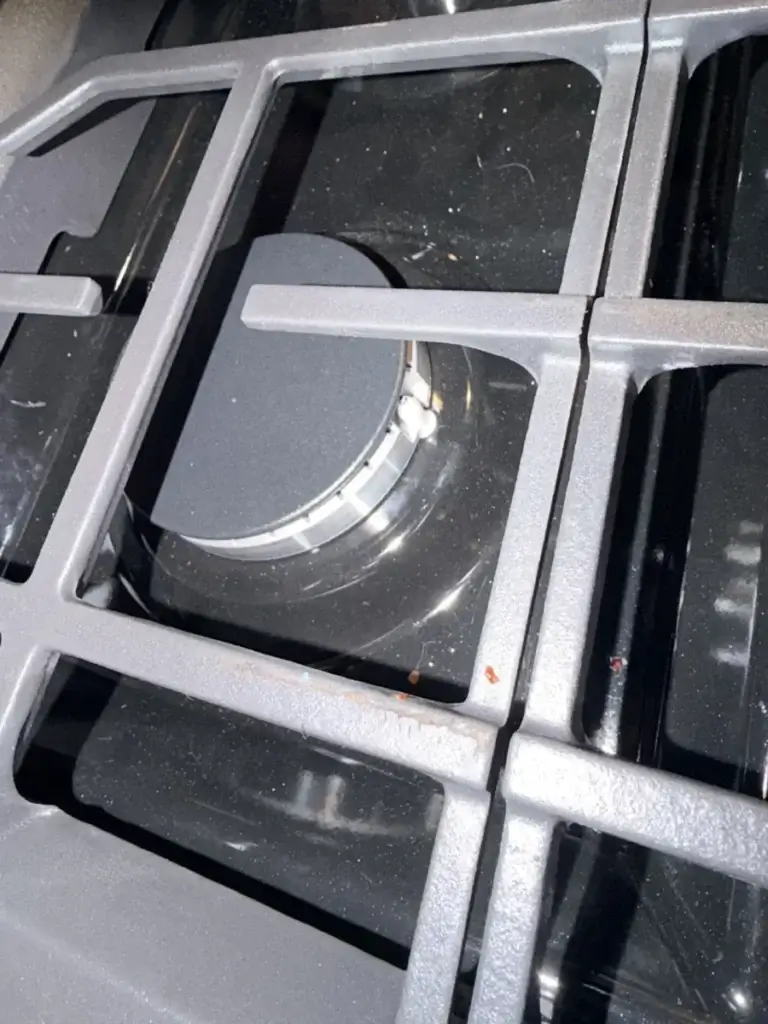
This is the cause that spikes every spring. Burner tubes on a built-in BBQ are an inviting home over the off-season — spiders in particular build webs and nests inside the venturi tubes, and a single web is enough to choke gas flow. The result is no light, a flame that creeps along only part of the burner, or yellow lazy flames that won’t reach the back of the grill. Food debris and grease also cake the small port holes along the top of each burner.
How to spot it: The grill ignites but only some ports light, the flame is uneven or yellow rather than crisp blue, or there’s a flame near the control valve instead of across the burner. With the gas off, lift the cooking grates and look down the burner — webs, nests, or blocked port holes are usually visible.
3. Failed igniter (battery, electrode, or spark module)
If the burner lights with a long match or grill lighter but the built-in igniter won’t fire it, the ignition system is the fault — not the gas. Most built-in grills use one of three ignition types: a battery push-button (a dead AA or AAA is the number-one igniter problem), an electronic spark module, or a piezo clicker. Over years outdoors, electrodes corrode, ceramic insulators crack, and spark wires loosen.
How to spot it: No clicking or a weak single click, no visible spark at the electrode, or it lights manually but never electronically. Swap the igniter battery first — it’s the cheapest, most common fix. If a fresh battery still gives no spark, the electrode or module is the next suspect.
4. Grease buildup or blockage
Years of cooking leave grease and carbon inside the burner tubes, around the ports, and in the venturi where air mixes with gas. Heavy buildup restricts flow the same way a clog does, and it’s also a flare-up and fire risk. A blocked venturi air intake throws off the gas-air mix, producing a yellow, sooty, low flame even when the tank is full.
How to spot it: Persistent yellow flames, soot on the underside of food or the lid, and flames that don’t respond well when you turn the knob up. Often paired with a grill that hasn’t had a deep clean in a season or more.
5. Regulator stuck in bypass — the low-flame culprit
This one is covered in its own section below because it’s so commonly misdiagnosed. In short: the safety mechanism inside the propane regulator can latch into a low-flow “bypass” state, and the result is every burner running on a weak low flame no matter how high you turn the knobs. See Stuck in bypass for the reset.
6. Burnt-out or corroded burners
Built-in BBQ burners live outdoors and eventually rust through, warp, or split. A burner with corroded-open holes or a cracked tube leaks gas in the wrong places and can’t hold a clean flame — you’ll see uneven flames, flames lifting off the burner, or a section that simply won’t carry fire even after cleaning. At that point the burner needs replacing, not just cleaning.
7. Gas-line or regulator fault (least common, tech-only)
The least common cause — but the most serious — is a fault in the gas supply line, a quick-connect fitting, or the regulator hardware itself. A pinched or damaged hose, a leaking fitting, or a failed regulator diaphragm starves the grill of fuel or, worse, leaks gas. This is not DIY territory: gas-line and regulator work in Ontario legally requires a TSSA-certified technician.
Brand notes: common failure points on Canadian-market built-in BBQs
The fuel-spark-flow logic is the same on every brand, but a few patterns are worth knowing on the built-in grills most common in Canadian outdoor kitchens. These are general field observations, not a substitute for diagnosing your specific unit:
- Napoleon (Canadian-built, very common here) — the electronic ignition modules and individual burner electrodes are the parts we most often see act up over time, and the stainless tube burners can corrode at the port holes after years outdoors. A weak or no-spark igniter and a fresh module battery are the usual first checks.
- Broil King — known for heavy cast burners that last, so on these the more common complaints are clogged or spider-webbed venturi tubes after a winter idle and igniter electrodes that need cleaning or replacing, rather than burnt-through burners.
- Weber — well-built grills where, on propane models, a regulator stuck in bypass (the low-flame-after-a-fast-connect problem) and crossover/igniter-electrode issues come up more often than burner failure; the slow-open-valve habit and a regulator reset clear most low-flame complaints.
Across all brands the common threads are the same: igniter modules and electrodes, the propane regulator bypassing, and burner/venturi corrosion or blockage. Anything touching the gas line, fittings, or regulator hardware is TSSA-certified work regardless of brand.
Safety first. If you smell gas (a rotten-egg odour) and it doesn’t clear after you shut the valve, turn everything off, leave the BBQ open, keep ignition sources away, and don’t try to light it — call for service. Never test for leaks with a flame; use soapy water on the fittings and watch for bubbles. Anything involving the gas line, the regulator, a propane-to-natural-gas conversion, or a persistent gas smell requires a TSSA-certified technician — that’s the law in Ontario, not just best practice.
The start-of-summer tune-up
Most “my BBQ won’t light” calls land in the first warm weeks of the year, and the reason is straightforward: the grill sat untouched all winter. A 20-minute tune-up before the first cook of the season prevents the majority of no-light and low-flame problems we get called out for.
- Clear the burner tubes. With the gas off, lift the grates and check each burner for spider webs, nests, and blocked ports. Run a burner brush or a thin wire through the ports and a venturi brush down the tubes.
- Fresh igniter battery. Replace the AA/AAA in the push-button igniter — it’s the cheapest insurance against a no-spark season.
- Inspect the hose and fittings. Look for cracks, chew marks, or kinks in the supply hose, and confirm the connection is snug. Brush soapy water on the fittings with the gas on and watch for bubbles.
- Deep-clean grease. Scrape the burners, clean the venturi air intakes, and empty the grease tray — both for flame quality and to cut flare-up risk.
- Reset the regulator and test. Open the tank valve slowly (see the next section), then light and run each burner on high for a few minutes to confirm a crisp blue flame across the full length.
Stuck in bypass: the low-flame mystery
If your built-in BBQ lights fine but every burner runs on a feeble low flame that won’t get hot — even on high — the propane regulator is almost certainly stuck in bypass mode. The regulator has a built-in safety that limits gas flow if it senses a sudden pressure drop, like the kind caused by opening the tank valve too quickly with the burners already on. Once tripped, it stays in the safe low-flow state until you reset it.
How to reset the regulator (the “bypass reset”):
- Turn off all the grill control knobs.
- Close the propane tank valve and disconnect the regulator from the tank.
- Wait 30–60 seconds for the regulator to reset to its normal state.
- Reconnect the regulator. With the grill knobs still off, open the tank valve slowly — a quarter turn, pause, then fully open.
- Now light the grill as usual. The flame should return to full height.
The lasting fix is habit: always open the tank valve slowly and with the burner knobs off, then turn the burners on. If the low flame returns even after a proper reset and a confirmed-full tank, the regulator may be failing — and replacing or servicing a regulator on a built-in gas line is TSSA-certified work, not a DIY swap.
Tank’s full, ports are clean, igniter sparks, and the built-in BBQ still won’t light or stay lit? That points to a regulator fault, a corroded burner, or a gas-line problem — gas-side components that need a TSSA-certified tech. Book a same-day GTA appointment: 647-834-4646 ($89 service call applied to the repair if you go ahead).
Safe 5-step DIY check
Set aside 15–20 minutes, a fresh igniter battery, a burner/venturi brush, and a spray bottle of soapy water. Always work with the gas off when cleaning or inspecting, and never test for leaks with a flame.
- Check the fuel and valves. Confirm the propane tank isn’t empty (gauge or lift-test) and that the tank valve plus any inline gas shutoff are fully open. On natural-gas grills, confirm the manual shutoff at the connection is open.
- Reset the regulator. If you get a low flame on every burner, do the bypass reset above — disconnect, wait a minute, reconnect, and open the valve slowly with the knobs off.
- Clean the burner ports. With the gas off, lift the grates and clear webs, nests, and blocked ports with a burner brush; run a venturi brush down each tube. This is the seasonal fix for most uneven or yellow flames.
- Replace the igniter battery. Swap in a fresh AA/AAA and test for a spark at the electrode. No spark with a new battery points to a corroded electrode or a failed spark module.
- Test the flame and check for leaks. Light each burner on high and confirm a crisp blue flame across the full burner. Brush soapy water on the hose fittings with the gas on; bubbling means a leak — shut off and call a pro.
What built-in BBQ repair costs
Honest answer: it depends on the diagnosis, which is why every visit starts with a flat $89 service call — a technician identifies the exact fault and gives you a firm all-in price before any work begins, and that $89 is applied to the repair if you go ahead. As a rough frame, the DIY-or-quick-service end (a regulator reset or a burner/venturi clean) is the least costly; replacing an igniter module, a corroded burner, or servicing the regulator sits in a typical mid-range; and a gas-line or hard-plumbed connection repair is the more involved end. Parts, labour, and a 90-day warranty are included in every quote, and the final figure is confirmed only after the diagnostic — never guessed over the phone. Because a built-in BBQ is a gas appliance, the same pricing logic as the rest of our gas work applies; see our gas appliance repair cost guide for typical ranges and how the $89 diagnostic anchors the quote.
Side burners, outdoor fridges & patio heaters
A built-in BBQ is rarely the only gas appliance in an outdoor kitchen, and the no-light and low-flame logic carries across:
- Side burners share the same fuel supply, igniter style, and bypass-regulator behaviour as the main grill — clean the ports, check the battery, and reset the regulator the same way.
- Patio heaters run on the same propane and regulator logic; a heater that won’t stay lit is often a tripped thermocouple or a dirty pilot, plus the same slow-open-valve rule to avoid bypass.
- Outdoor fridges are electric, not gas, but they’re part of the same outdoor-kitchen build — if one isn’t cooling, that’s a separate diagnostic we handle on the same visit.
If your whole outdoor kitchen needs a once-over, our outdoor kitchen & built-in BBQ repair service covers the grill, side burners, patio heaters, and outdoor refrigeration in one appointment.
When to call a TSSA-certified pro
Call us if any of these apply:
- You smell gas and it doesn’t clear after shutting the valve — shut everything off and call before relighting
- The fault is in the gas line, a quick-connect fitting, or the regulator hardware — gas-side work that legally requires a TSSA-certified tech in Ontario
- You want a propane-to-natural-gas conversion (or the reverse) — conversions must be done by a certified technician with the correct orifices
- The low flame returns after a proper regulator reset and a confirmed-full tank (failing regulator)
- A burner is corroded, cracked, or warped and needs replacing
- Soapy-water testing shows bubbles at a fitting (a confirmed leak)
- You’re not comfortable working around gas, or the grill is hard-plumbed into a built-in outdoor kitchen
Appliance Forever covers the entire GTA, York Region, and Simcoe County — Vaughan, Markham, Aurora, Newmarket, Bradford, Barrie, Innisfil, Scarborough, North York, Richmond Hill, and beyond. We’re TSSA-certified for natural gas and propane, and our $89 service call applies to the repair. Book same-day at 647-834-4646 or see our outdoor kitchen & BBQ repair service. For a related gas-safety read on what flame colour tells you, see why a gas stove burns orange instead of blue.
FAQ — quick answers
Why won’t my built-in BBQ light?
Work through the fuel-spark-flow chain. First rule out an empty propane tank or a closed gas valve — the most common cause. Next, check for clogged burner ports or spider webs (very common after a winter idle), then a dead igniter battery or worn electrode. If it lights but runs on a weak low flame, the regulator is likely stuck in bypass and needs a reset. Anything involving the gas line, fittings, or regulator hardware is a TSSA-certified job.
Why does my gas grill light but only burn with a low flame?
That’s the classic sign of a propane regulator stuck in bypass mode. It usually happens when the tank valve is opened too quickly with the burners on, tripping the regulator’s safety into a low-flow state. To reset: turn off all knobs, close and disconnect the tank, wait 30–60 seconds, reconnect, then open the tank valve slowly with the burners off. If the low flame returns after a proper reset and a full tank, the regulator may be failing and needs a certified tech.
How do I clean clogged burner ports on a built-in BBQ?
With the gas fully off, lift the cooking grates and look down each burner for spider webs, nests, and blocked port holes. Use a burner brush or a thin wire to clear the small ports along the top, and run a venturi brush down the burner tubes. This single step fixes most uneven, yellow, or partial flames — especially the first time you fire up the grill in spring.
My BBQ igniter won’t spark — what’s wrong?
Start with the cheapest fix: replace the igniter battery (usually an AA or AAA in the push-button). A dead battery is the number-one igniter problem. If a fresh battery still gives no spark, look for a corroded or cracked electrode, a loose spark wire, or a failed spark module. You can still light the grill safely with a long lighter while you sort out the igniter.
Is it safe to use a BBQ that won’t light properly or smells like gas?
If you smell gas (a rotten-egg odour) that doesn’t clear after shutting the valve, stop — turn everything off, leave the lid open, keep flames and sparks away, and don’t try to light it. Never test for leaks with a flame; use soapy water and watch for bubbles. A grill that won’t light cleanly can also pool unburned gas, so don’t keep clicking the igniter repeatedly. When in doubt, shut the gas and call a TSSA-certified technician.
Do I need a TSSA-certified technician to fix my built-in BBQ?
For DIY-safe tasks — checking fuel, resetting the regulator, cleaning ports, replacing the igniter battery — no. But in Ontario, any work on the gas line, gas fittings, the regulator hardware, the burners’ gas connections, or a fuel conversion legally requires a TSSA-certified technician. Appliance Forever is TSSA-certified for both natural gas and propane.
How much does built-in BBQ repair cost in the GTA?
It depends on the diagnosis. A regulator reset or a burner clean is at the low end; a burner, igniter module, or regulator replacement is more. Our $89 service call covers the on-site diagnosis and is applied to the repair if you go ahead, every job is quoted before any parts work, and repairs are backed by a 90-day warranty. Call 647-834-4646 for a same-day appointment.
Built-in BBQ still won’t light or hold a flame after the DIY checks?
Book a same-day appointment across the GTA, York Region, and Simcoe County. Our $89 service call is applied to the repair, the final price depends on the diagnosis, and every repair is backed by a 90-day warranty. TSSA-certified for natural gas and propane.
Call now: 647-834-4646 | Book your service online
 Rating
Very helpful! Knew the issue right away and fixed within a week. Would recommend

Good guy

Very patient helpers and expert fixers

Very pleased and satisfied with the repair on my Jennair Double Wall Oven. Communication was excellent from beginning to end of Service. Highly recommend Appliance Forever for all Appliance repairs.

Appliance Forever came to fix our Refrigerator. They were knowledgeable, professional and very efficient. Very pleased with their work!

Fixed my KitchenAid oven very fast. Great guys both Zack and George. If anything breaks in my kitchen I will call them back.

Superb assistance! Thanks to Applianceforever, my washing machine is operating like new again. Very dependable and effective!

Excellent service fast and and friendly . Pleasant service

Excellent service! Appliance Forever fixed my fridge quickly and did an amazing job. The technician was professional, friendly, and efficient. My fridge is working perfectly now. I highly recommend them to anyone needing appliance repairs. Thank you!

Applianceforever is incredible! My refrigerator was promptly and expertly mended by them. I heartily endorse their services.

5-Star Review for Appliance ForeverI first got acquainted with Appliance Forever last year when they came to repair my dishwasher under warranty. Zak arrived for the inspection, quickly identified the issue, and explained that a replacement part needed to be ordered under warranty. He also informed me how long the process would take. The parts arrived on time, and Zak returned to replace and install everything perfectly. The entire service was completed promptly and professionally.Just recently, my oven suddenly stopped working. I called Zak, and to my surprise, he was able to come by within an hour. He quickly diagnosed the issue, and fortunately, he had the necessary part in stock. The repair was done thoroughly, carefully, and incredibly fast.I’m giving 5 stars for the outstanding service, professionalism, and efficiency. I highly recommend Appliance Forever for any appliance repair needs!

Friendly and super fast service. George got my stove and running in no time! Really appreciate their work!

Vlad was very professional and quick. Thank you

We’re professional and very helpful.

Zack and George great guys amazing service they know all their stuff. Great job.!!!