

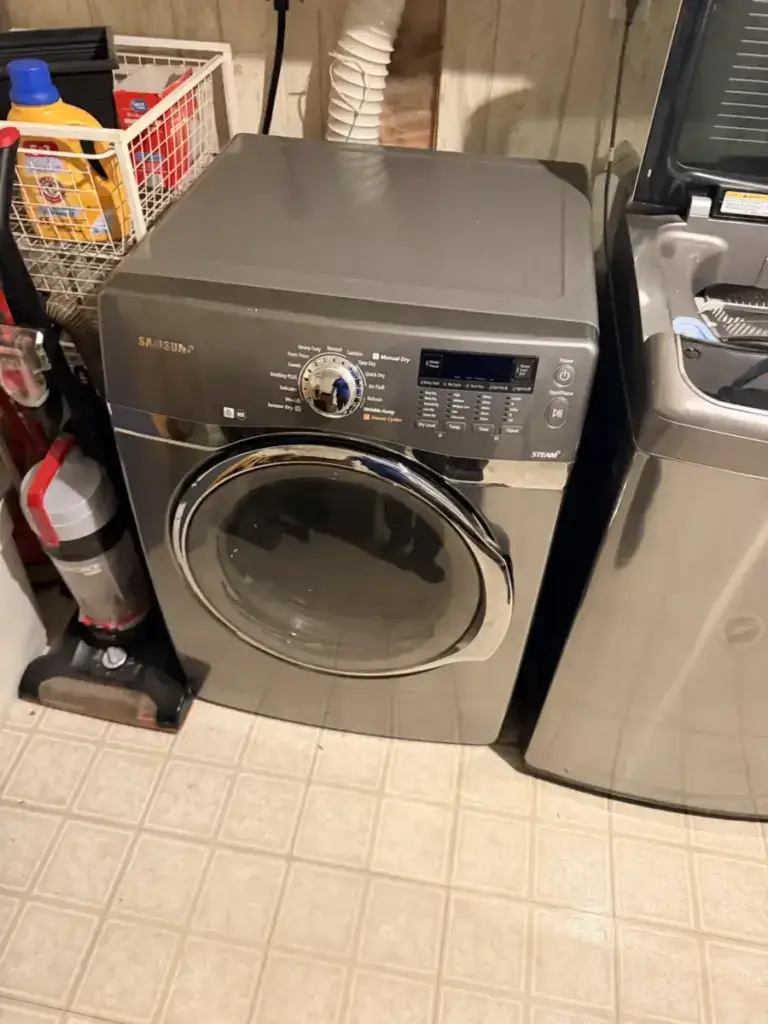
3-second answer: If your Samsung dryer runs and tumbles but the clothes come out cold and damp, it has lost its heat source. On Samsung dryers (the DV-series) the no-heat fault is almost always one of three things: a blown thermal fuse — the most common cause, and nearly always triggered by a clogged vent — a burnt-out heating element on electric models, or failed gas valve coils on gas models. Samsung also flags heat problems with the HE and HE2 error codes. Most of these are diagnosable in 15 minutes with a $15 multimeter, and the electric-side parts are DIY-fixable on a 240V dryer. Gas-side work in Ontario — anything past the thermal fuse — is a job for a TSSA-certified technician. This guide is the Samsung-specific companion to our broader clothes dryer not heating guide.
In this guide
The 6 most common causes of a Samsung dryer not heating
A Samsung dryer runs two independent systems — the motor that spins the drum, and the heat source. When the drum still tumbles but the clothes stay cold, the fault sits somewhere in the heat circuit, not the motor. Across the GTA, York Region, and Simcoe County, here are the six causes we see most often on Samsung DV-series dryers, in roughly the order you should rule them out.
- Blown thermal fuse — most common, usually downstream of a clogged vent
- Burnt-out heating element — electric models
- Tripped or failed thermal cut-off / thermostat
- Clogged vent / lint restriction — the real root cause behind most fuse blows
- Failed gas valve coils — gas models
- Control board fault — least common
1. Blown thermal fuse (most common)
This is the single most common cause of a no-heat Samsung dryer — and the one most people misdiagnose. The thermal fuse is a small one-shot safety device, mounted on the heater housing or blower assembly, that physically melts open if the exhaust temperature climbs past a safe limit. Once it’s blown, no current reaches the heater and the drum tumbles cold air. A thermal fuse does not reset — it has to be replaced (a $10–20 part).
The catch: a thermal fuse rarely blows on its own. It blows because something upstream made the dryer overheat — the overwhelming majority of the time that’s a clogged vent. Replace the fuse without clearing the vent and the new fuse blows again on the next heavy load.
How to spot it: No heat at all, but the drum tumbles and the cycle timer advances normally. Multimeter test (dryer unplugged): probes on the two fuse terminals should read near-zero ohms (continuity). An open circuit (OL / infinity) means it’s blown.
2. Burnt-out heating element (electric models)
On an electric Samsung dryer the heating element is a coiled resistance wire inside a stainless housing on the back wall of the cabinet. It runs on 240V. After years of daily cycling the coil eventually corrodes, breaks, or develops a hot spot that arcs to the housing. When it fails open, the drum still tumbles but the air stays cold.
How to spot it: Drum tumbles, thermal fuse tests good, but no heat. Multimeter across the element terminals should read roughly 10–15 ohms on a healthy element; infinity means it’s burnt out. A visible glow while running means the element itself is fine and the fault is elsewhere (often a thermostat).
3. Tripped thermal cut-off or failed thermostat
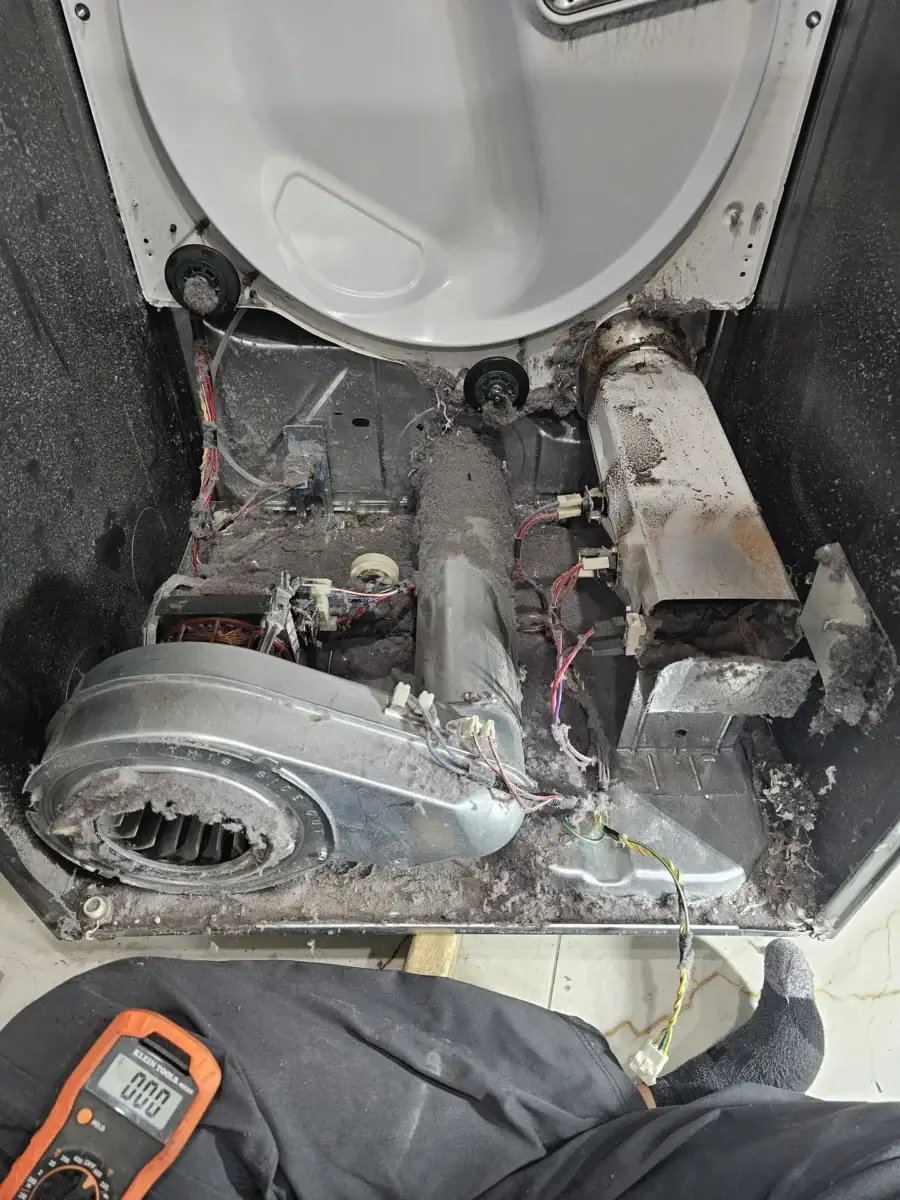
Samsung dryers carry a thermal cut-off fuse and a high-limit thermostat on the heater housing as a second layer of overheat protection. The high-limit thermostat self-resets when temperatures drop; the thermal cut-off is one-shot like the main thermal fuse. If a thermostat has failed open — or a cut-off has tripped and not been replaced — the heat circuit stays broken and the dryer reads as no-heat. These faults are usually caused by the same overheating that comes from a restricted vent.
How to spot it: With the dryer unplugged and cool, a multimeter should show continuity across each thermostat / cut-off. An open circuit on a cool dryer means that part has failed and needs replacement.
4. Clogged vent / lint restriction
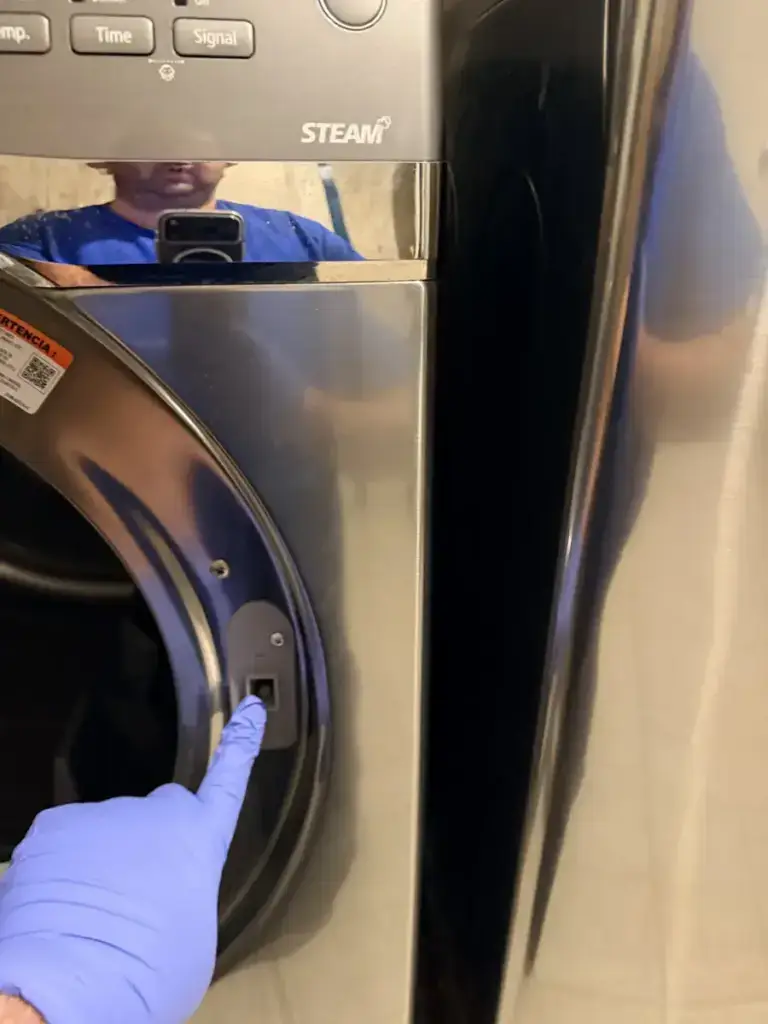
This is the root cause behind a huge share of Samsung no-heat calls — and the one most owners don’t recognize as a vent problem, because the visible symptom looks exactly like a dead element. A clogged vent restricts exhaust airflow, drum and housing temperatures spike, the thermostats trip, the thermal fuse eventually blows, and the dryer goes no-heat. Clear the part without clearing the vent and you’re back to no-heat within days.
This matters for more than just performance: a clogged, lint-packed dryer vent is a well-known fire hazard and one of the leading causes of dryer fires, which is why fire-safety authorities consistently urge regular vent cleaning. If you can’t remember the last time the full vent run was cleaned (dryer exhaust port → flex hose → wall duct → exterior cap), that’s where to start before replacing any parts.
How to spot it: A history of “drying takes longer than it used to,” repeated thermal-fuse blows, and a cabinet that’s hot to the touch within 20 minutes of starting. Lint trickling weakly from the exterior cap rather than puffing freely points to a restriction.
5. Failed gas valve coils (gas models)
On a gas Samsung dryer, two or three small electromagnetic coils sit on top of the gas valve. When the cycle calls for heat, the control energizes the coils, the plungers lift, gas flows to the burner, and the igniter lights it. If a coil weakens — a typical failure after several years — the plunger doesn’t lift far enough, gas doesn’t flow, and you get the classic gas no-heat symptom: the igniter glows orange, glows hotter, then turns off without ever igniting gas. Drum keeps tumbling, no heat.
How to spot it: Watch the igniter through the lower access panel during a heat cycle. If it glows brightly and cycles off without ever lighting the gas, the coils are weak. Coils are sold and replaced as a kit, never individually — and this is gas-side work that requires a TSSA-certified technician in Ontario.
6. Control board fault (least common)
The least common cause — but a real one — is the main control board failing to send the heat-call signal even though every component downstream is healthy. This is what’s usually behind a persistent HE code that returns immediately after the thermal fuse, element, and thermostats have all tested good. Board diagnosis and replacement is a tech-level job; don’t replace a board on a guess.
Samsung error codes that signal a heat problem
Samsung DV-series dryers surface heat-circuit faults with a handful of codes. They point you at the system, not the exact part — you still need to test — but they narrow the search:
If a heat-related code clears on a power-cycle and never returns, it was likely a transient sensor glitch. If it comes back immediately, you have a real fault to diagnose. The Samsung-specific access procedure and full code list are on our Samsung appliance repair page, and you can look up faults for every brand we service in our appliance error code library.
Safety first. Before opening any panel, unplug an electric dryer — or, on a gas dryer, flip the breaker and shut the gas valve at the dryer. Never work on a gas-side component (gas valve, supply line, burner, coils) yourself: in Ontario that work legally requires a TSSA-certified technician.
5-step DIY diagnostic
Set aside 30 minutes, a $15 multimeter, a Phillips and flathead screwdriver, and a nut driver set. Always cut power (and gas, on a gas dryer) before opening a panel. Work in this order:
- Confirm power and gas supply. Electric Samsung dryers are fed by TWO 240V breakers. If only one leg trips — more common than you’d think — the dryer tumbles on 120V but won’t heat, because the heater needs both legs. Reset both breakers firmly. Gas model: confirm the gas-line shutoff at the dryer is open (handle parallel to the pipe).
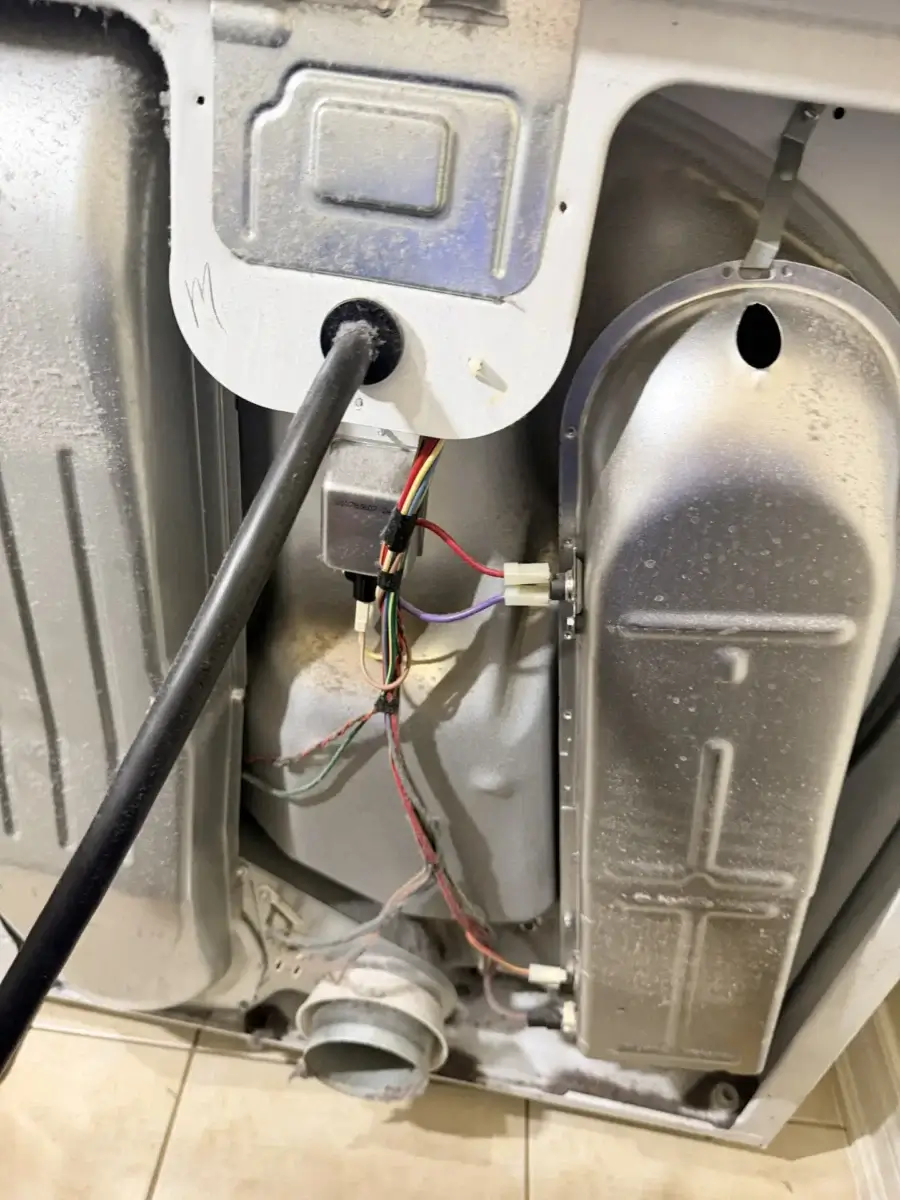
- Test the thermal fuse. Unplug the dryer. Pull the back panel (usually screws along the top edge). Locate the thermal fuse on the heater housing — small white ceramic body, two wire terminals. Disconnect one wire and put a multimeter (continuity) across both terminals. Healthy = beep / near-zero ohms. Open = blown; replace it ($10–20) and clean the vent, or it’ll blow again.
- Inspect the vent end-to-end. Pull the dryer forward, disconnect the flex hose, clean it outside, and clear both ends plus the dryer exhaust port and the exterior wall cap. Confirm the cap flap moves freely. A surprising number of “dead element” Samsung calls turn out to be vent jobs.
- Test the heating element (electric) or igniter (gas). Electric: multimeter across the element terminals — healthy reads 10–15 ohms; infinity means burnt out. Gas: multimeter across the igniter leads — healthy reads 50–400 ohms; infinity means cracked.
- Isolate thermostat or gas-valve faults. If the fuse, vent, and element/igniter all check out, test the high-limit thermostat and thermal cut-off with the multimeter at room temperature (continuity expected; infinity = failed open). On a gas dryer, if the igniter glows but no gas ever lights, the gas valve coils are the suspect — and that’s TSSA-certified service in Ontario, not a DIY part.
Thermal fuse good, vent clean, element or igniter tests fine, and the Samsung still won’t heat? That points to a control-board fault, a gas valve coil needing gas-side service, or a wiring break — components that need a tech. Book a same-day GTA appointment: 647-834-4646 ($89 service call applied to the repair if you go ahead).
Electric vs gas Samsung dryers — which parts matter for you
Knowing which type you own narrows the diagnostic right away. Electric Samsung dryers use a 240V resistance heating element and have no igniter or gas valve coils. Gas Samsung dryers burn natural gas or propane through an igniter and gas valve and have no resistance element. Both share the thermal fuse, both thermostats, and the thermal cut-off.
Telling them apart is easy: a gas dryer has a yellow flexible gas line at the back and runs on a normal 120V outlet; an electric dryer has a heavy 240V plug (3- or 4-prong) and no gas line.
Electric model: rule out thermal fuse → heating element → thermostats / cut-off, then the board. Skip the gas sections. Gas model: rule out thermal fuse → igniter → gas valve coils → thermostats, then the board — and book a TSSA-certified tech for anything past the fuse.
When the thermal fuse keeps blowing
If you’ve replaced the thermal fuse on your Samsung and it blew again within a week — sometimes inside a single load — stop changing fuses and investigate the heat source. The fuse is doing exactly what it’s built to do: cutting power when the exhaust temperature gets dangerous. Something is making the exhaust too hot. In descending order of frequency:
- A vent blockage you missed. The whole run, not just the first stretch — lint often balls up just past the blower where you can’t see it from outside, and at the bird-screen on the exterior cap.
- A thermostat failed closed. If the operating thermostat that’s supposed to cut heat at the target temperature welds shut, the heater never stops, the drum overheats, and the cut-off and thermal fuse take the hit.
- A restricted or collapsed flex hose. A crushed transition hose behind the dryer chokes airflow and spikes exhaust temperatures even when the rest of the vent is clear.
Past two thermal-fuse replacements in a row, this is genuinely a job for a tech — both to save time and because the underlying overheat is a real fire risk you shouldn’t leave on a “let’s try one more fuse” cycle.
When to call a GTA Samsung pro
Call us if any of these apply:
- It’s a gas Samsung dryer and the fault isn’t a clogged vent or a blown thermal fuse — anything past those two is gas-side work and legally requires a TSSA-certified tech in Ontario
- You’ve replaced the thermal fuse and it blew again
- An HE / HE2 code returns immediately after a power-cycle and the element and thermostats test good (points to the board or thermistor)
- The dryer trips the breaker when you start a heat cycle
- There’s a burning-electrical smell when it runs
- The drum stops tumbling at the same moment the heat cuts out (suggests a wiring or control-board fault, not a heat-circuit fault)
- You don’t have a multimeter, or you’re not comfortable working inside a 240V appliance
Appliance Forever covers the entire GTA, York Region, and Simcoe County — Vaughan, Markham, Aurora, Newmarket, Bradford, Barrie, Innisfil, Scarborough, North York, Richmond Hill, and beyond. We’re TSSA-certified for gas dryers and factory-trained on Samsung and 30+ other brands, and our $89 service call applies to the repair. Book same-day at 647-834-4646 or browse our dryer repair services. For the broader, brand-neutral version of this guide, see clothes dryer not heating: 7 causes and DIY fixes.
FAQ — quick answers
Why is my Samsung dryer running but not heating?
The drum motor and the heat circuit are separate systems, so a Samsung dryer can tumble normally while producing no heat. The fault is somewhere in the heat circuit: a blown thermal fuse (most common, usually from a clogged vent), a burnt-out heating element on electric models, failed gas valve coils on gas models, a tripped thermostat or thermal cut-off, or — least often — the control board. Start by testing the thermal fuse and cleaning the vent.
What does the HE code on a Samsung dryer mean?
HE = heater error. The control board can’t see the heating element drawing the expected current. Most HE codes resolve by replacing the heating element or the thermal fuse; a smaller share are caused by a bad thermistor on the heater housing feeding the board false temperature readings. If HE returns immediately after a power-cycle, you have a real fault to diagnose rather than a sensor glitch.
What’s the difference between HE and HE2 on a Samsung dryer?
HE points at the heating circuit not drawing current as expected (element or thermal fuse). HE2 is an overheat code — the same family as a tripped high-limit thermostat — and very often comes down to a restricted vent making the dryer run too hot. For HE2, clean the full vent run before replacing any parts.
How do I tell if my Samsung dryer’s thermal fuse is blown?
Unplug the dryer and pull the back panel. Find the thermal fuse on the heater housing — a small white ceramic body with two wire terminals. Disconnect one terminal wire and put a multimeter on continuity across the two terminals. A healthy fuse beeps or reads near zero ohms; an open circuit (no beep, OL) means it’s blown. The replacement is a $10–20 part — but clean the vent at the same time, because a clogged vent is what blew it.
Can I replace a Samsung dryer heating element myself?
If it’s an electric Samsung dryer and you’re comfortable working inside a 240V appliance with the unit unplugged: yes. Pull the back panel, disconnect the element’s two leads, unscrew the housing, swap in the new element oriented the same way, reconnect, reinstall the panel, and run a test cycle. A gas Samsung dryer has no heating element — it has an igniter and gas valve coils, both of which require TSSA-certified service in Ontario.
How much does it cost to fix a Samsung dryer that won’t heat in the GTA?
It depends on the diagnosis. A thermal fuse plus a vent clean is at the low end; a heating element or gas valve coil replacement is more — see our dryer repair cost guide for the GTA for typical ranges. Our $89 service call covers the on-site diagnosis and is applied to the repair if you go ahead, every job is quoted in writing before any parts work, and repairs are backed by a 90-day warranty. Call 647-834-4646 for a same-day appointment.
Do you service gas Samsung dryers in the GTA?
Yes — Appliance Forever is TSSA-certified for gas appliances, which is the legal requirement in Ontario to work on gas-side components such as the gas valve, supply line, burner, and igniter. We handle both electric and gas Samsung dryers same-day across the GTA, York Region, and Simcoe County. Call 647-834-4646 — $89 service call applied to the repair.
Samsung dryer still won’t heat after the DIY diagnostic?
Book a same-day appointment across the GTA, York Region, and Simcoe County. Our $89 service call is applied to the repair, the final price depends on the diagnosis, and every repair is backed by a 90-day warranty. TSSA-certified for gas dryers and factory-trained on Samsung.
Call now: 647-834-4646 | Book your service online